Agent-native architecture: count the buttons before you build the agent
A parity map, one registry for UI and agent, and a gate on irreversible actions. Six steps to make an existing product agent-native, with code to copy.

Most products that added an “agent” this year fail a ten-minute test. You don’t need a framework, and you don’t need to pick a definition. You need one spreadsheet, and you need to count buttons.
Wait, which definitions? In August 2026 Shiplight counted at least six published definitions of agent-native, and some of them aren’t even about the same thing. Gartner used the term back in February 2025, about infrastructure. a16z wrote “agent-native architecture” in March 2025, in a post about MCP. The version that stuck with developers came later. In January 2026 Dan Shipper of Every wrote a guide together with Claude, based on what they learned building Reader and Anecdote. On May 5, 2026 the gmays.com blog described a few months of spending roughly $1,000 a month on tokens just to figure out what it means. His answer is simple: in normal software the human operates. In agent-native software the agent operates and the human supervises. Three days later Builder.io published the five-principles version.
One test survives the whole debate, and Shiplight put it best: does the agent finish the task end to end, or hand it back to a human halfway through? Builder.io wrote the other side of the same test:
A chatbot in the corner can summarize a document or draft a response, but it usually cannot do everything you can do in the product.
— Builder.io, “Agent-Native: The Next Architecture for Software”, May 8, 2026
That’s the whole story. So here’s how I’d walk through an existing product. The example is an internal CRM, because that’s exactly the question gmays asks: would you trust an agent to work alone in your CRM?
01 · Count actions, not features
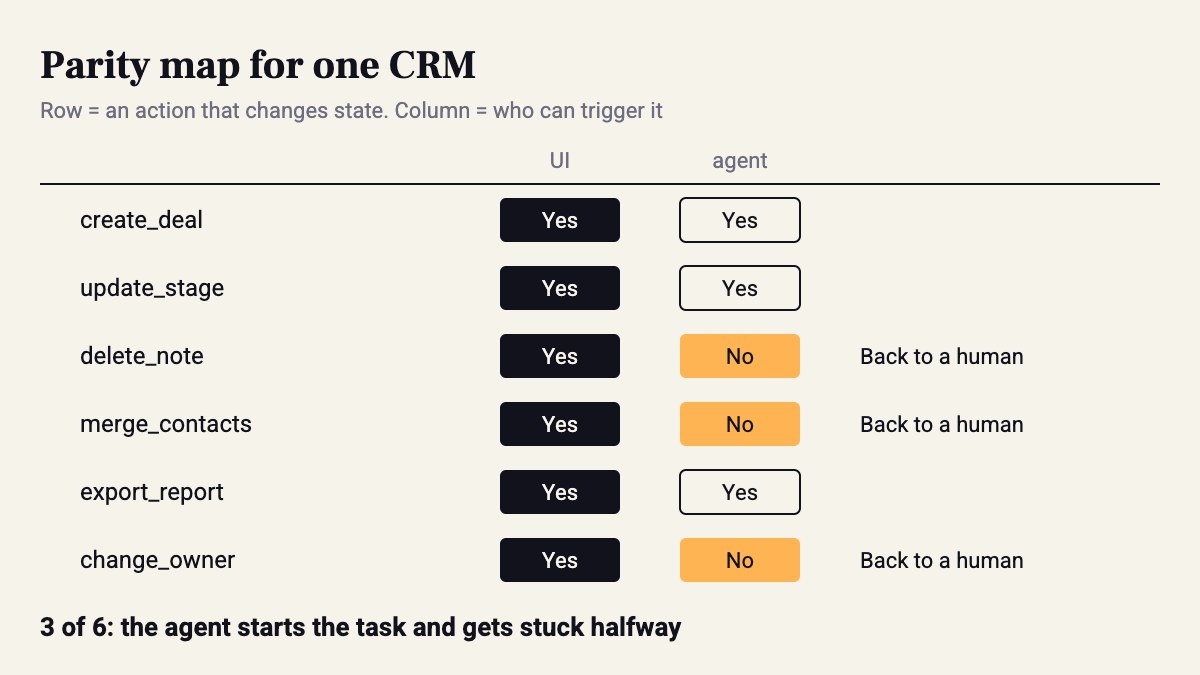
Go through the UI and list every action that changes state: save, delete, change owner, merge, export. Next to each one, add a column: is there a tool the agent can call that does exactly this? Shipper calls this Parity and ranks it as the most important rule. If a user can delete a note and the agent can’t, the agent is stuck under a ceiling.
In practice you almost always see the same picture: reads are covered, writes aren’t. The agent can summarize a deal but can’t move it to the next stage. A quick starting point, if your routes are in FastAPI or Flask:
grep -rhoE '@(app|router)\.(post|put|patch|delete)\("[^"]+' src/ \ | sed -E 's/.*\("//' | sort -u > ui_actions.txtwc -l ui_actions.txtEvery line in that file needs a matching tool. The lines without one are where the agent will give up and hand the task back to you.
02 · One action, two entry points
The common mistake: writing an “API for the agent” next to the UI’s API. Two months later, the validation someone added to the form doesn’t exist in the tool, and the agent does things a user can’t. Builder calls the fix a shared action model: the UI and the agent call the same function, with the same permissions, and leave the same trail.
The pattern I recommend copying: one action registry, and a run_action that everything goes through.
import json, timefrom dataclasses import dataclassfrom typing import Callable
@dataclassclass Action:    name: str    fn: Callable    reversible: bool = True
ACTIONS: dict[str, Action] = {}
def action(reversible: bool = True):    def wrap(fn):        ACTIONS[fn.__name__] = Action(fn.__name__, fn, reversible)        return fn    return wrap
def run_action(name: str, actor: str, approved: bool = False, **kwargs):    a = ACTIONS[name]    if actor.startswith("agent:") and not a.reversible and not approved:        return {"status": "needs_approval", "action": name, "args": kwargs}    result = a.fn(**kwargs)    with open("audit.jsonl", "a") as f:        f.write(json.dumps({"ts": time.time(), "actor": actor, "action": name,                            "args": kwargs, "result": result}, default=str) + "\n")    return {"status": "ok", "result": result}
@action()def update_stage(deal_id: str, stage: str) -> dict:    """Move a deal to another pipeline stage."""    ...  # your DB call
@action(reversible=False)def delete_note(note_id: str) -> dict:    """Delete a note permanently."""    ...  # your DB call
The UI route becomes one line: return run_action("update_stage", actor=f"user:{uid}", deal_id=deal_id, stage=stage). From now on parity isn’t a matter of discipline. It falls out of the structure.

03 · Break up the fat tool
Shipper gives a good example: classify_and_organize_files locks the logic into code. read_file and move_file leave the agent room to use judgment, including on edge cases you didn’t think of. In a CRM that means not exposing cleanup_pipeline, but list_deals, update_stage, add_note. Then a new feature, say “close every deal that hasn’t moved in 90 days and leave a note explaining why”, is a prompt, not a deploy. Shipper calls this composability.
And what shows up in the logs? More tool calls per task, and more tokens.
Caveat: granularity isn’t free. Every extra primitive is another loop iteration and more context, and gmays didn’t burn $1,000 a month for nothing. I keep a complex action as a single tool when it’s fully deterministic and involves no decisions, and break up only what actually needs judgment.
04 · Expose the same registry over MCP
For Builder, protocol-readiness is a principle of its own: MCP today, A2A later. If you did step 02, this is ten lines, and every agent call goes through the same run_action:
import functoolsfrom mcp.server.fastmcp import FastMCPfrom actions import ACTIONS, run_action
mcp = FastMCP("crm")
def as_tool(a):    @functools.wraps(a.fn)    def tool(**kwargs):        return run_action(a.name, actor="agent:mcp", **kwargs)    return tool
for a in ACTIONS.values():    mcp.add_tool(as_tool(a), name=a.name, description=a.fn.__doc__)
if __name__ == "__main__":    mcp.run()
Note that approved isn’t exposed to the agent. It can’t approve itself.
Now run the official inspector: npx @modelcontextprotocol/inspector python server.py. The tool list there should match ui_actions.txt. The gap is no longer buried in code. It’s a list in front of you.
05 · Every action leaves a receipt
gmays insists on this: not blind trust, but supervision, receipts and reversible execution. Builder calls it governed execution. In the code above it’s two lines: an action with reversible=False returns needs_approval to the agent instead of running, and every run is written to audit.jsonl with actor, args and result.
Why block and not just log? Because we’ve already seen what happens without it. In July 2025 Replit’s agent deleted SaaStr’s production database, during a code freeze, after being told explicitly not to touch anything. Jason Lemkin documented it in real time. The model wasn’t the problem. The problem was a system that let an irreversible action run without a gate.
Also, make sure the agent can read the audit log. Shiplight stress readable state, no screenshots. An agent that can see what it did yesterday doesn’t do it again today.
06 · Measure the leash
For gmays, trust is the whole point: as confidence in the output grows, the leash gets longer. That’s also the metric. Start with the smallest yes: one narrow task where a mistake costs little.
So what do you actually measure? Two numbers a week from the audit log: how many tasks the agent finished without handing back to a human, and how many of its actions were later reverted. A rough start:
jq -r 'select(.actor|startswith("agent:")) | .action' audit.jsonl | sort | uniq -c
The rule I like: an action moves from “needs approval” to “runs alone” only after a bar you set in advance, say 50 approved runs in a row with no revert. Not a feeling. A number.
What to take away
- Every new UI button goes into the PR together with its tool. No tool, no merge.
- UI and agent call the same
run_action. A separate API for the agent is a parity gap waiting to blow up. - A tool that decides for the agent is a hidden workflow. Break it up, except for what’s fully deterministic.
- The agent never deletes anything on its own that has no undo. Replit already paid for that lesson for you.
Sources
How this was made: drafted by our agent from 4 sources, edited and approved by Koby Almog.


