Claude Design up close: the tool that reads your repo and draws you a deck
Anthropic's Claude Design: what it builds, how it learns your design system from code, what it costs, where it fails, and when Open Design or Figma win.
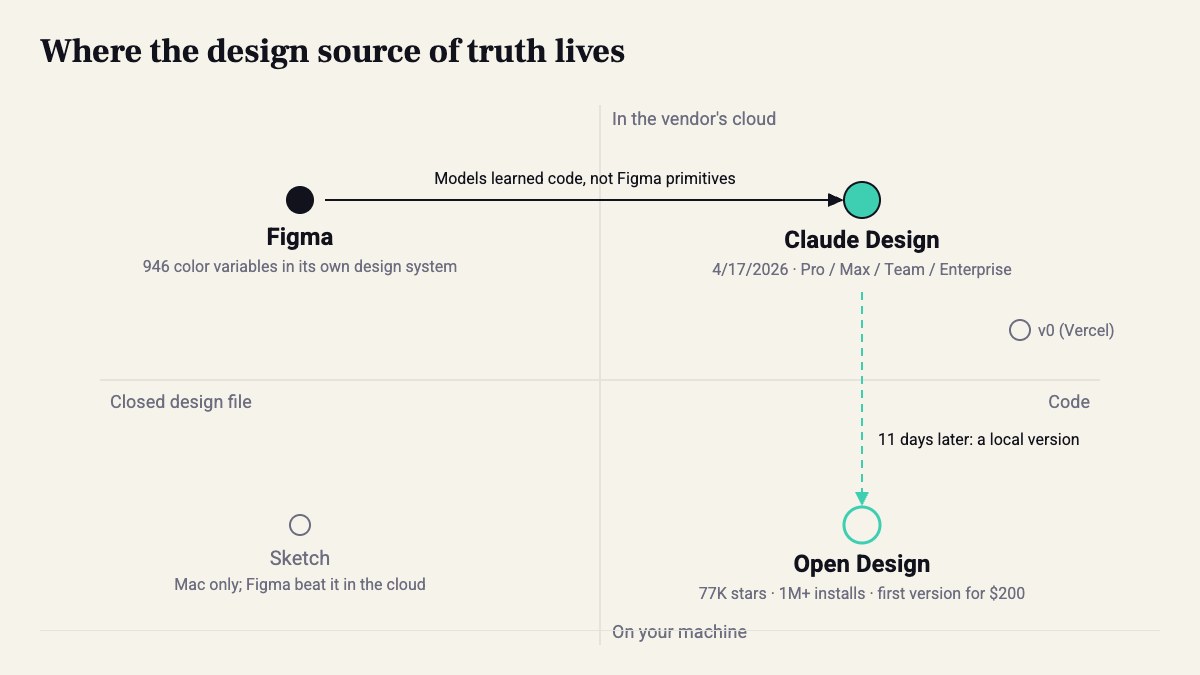
On April 18, 2026, a day after Anthropic launched Claude Design, designer Sam Henri Gold opened one file on his blog: Figma’s own design system. Not a client’s. Figma’s. 946 color variables, grouped in folders like bg/desktopBackgrounded, each with eight modes: Light and Dark, plus variants for FigJam, DevMode and Slides. He wrote the post a few hours after trying Claude Design for the first time, and his argument is short. Models trained on code, not on Figma’s primitives. So the design source of truth moves back to code, and the tool that can read code wins.
This is the fourth and final part of the series. After Codex, Grok Bot and ChatGPT, this time it’s a tool Anthropic doesn’t even sell to developers. That’s exactly why you should know it: the first thing it does is ask for access to your repo.
What it is, and what it isn’t
Claude Design is an Anthropic Labs product, the company’s experiments unit. Roughly: a canvas where you describe what you need, Claude builds a first version, and you refine it together. According to the official announcement, the outputs are designs, prototypes, slide decks and one-pagers. At launch it ran on Opus 4.7, which Anthropic called its strongest vision model, and it’s still labeled a research preview.
Now what it isn’t, because that’s where most of the confusion is:
- It’s not an artifact. Artifacts in claude.ai chat are a single piece of HTML or React inside a conversation. Claude Design is a workspace: projects, a persistent design system, comments on the canvas, export.
- It’s not Claude Code. It reads the codebase during onboarding, but it doesn’t write to the repo. When a wireframe is ready, you hand it to Claude Code, and Claude Code implements it.
- It’s not Figma. There’s no vector file with components and variants. The output is code-based, so a prototype can include voice, video, shaders, 3D and built-in AI. A Figma file can’t run that.
- It’s not Cowork. Cowork is a general agent for non-programmers’ tasks. Design is one tool, for visual work.
First session: what happens when you open it
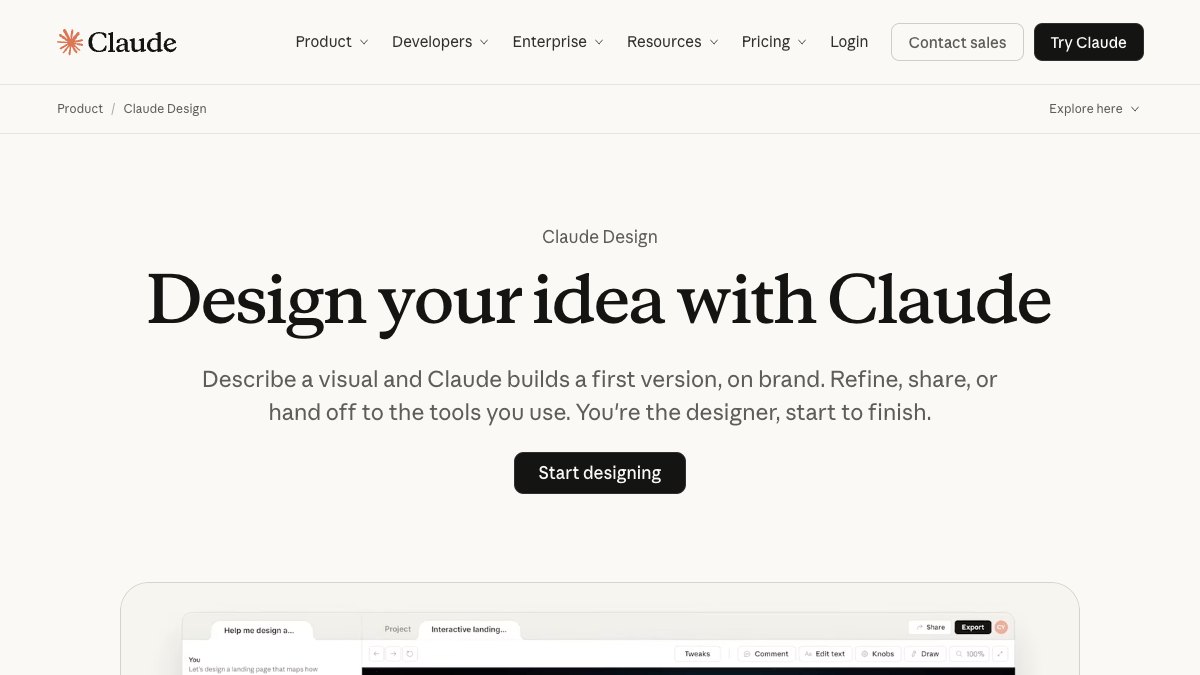
Per the launch, the flow goes like this. First, onboarding: Claude reads the codebase and design files and builds a design system for the team. Colors, typography, components. From then on every new project uses them automatically, and you can keep more than one system, say one for product and one for marketing.
Then the prompt. Anthropic described the working phase like this:
Describe what you need and Claude builds a first version. From there, you refine through conversation, inline comments, direct edits, or custom sliders (made by Claude) until it’s right. — Anthropic, launch announcement, April 17, 2026
The sliders are the nicest part. Claude builds custom controls for each design: density, heading size, how much color. Instead of typing “make it a bit airier” five times, you move a slider. Just ask for them, and say exactly which ones.
In practice, the first prompt decides how many rounds you’ll go through. Write a brief the way you’d write one for a freelance designer, not a single line:
What: product one-pager, one portrait A4 pageFor: CTO at a 200-developer company, will read it for 40 secondsMust: the 3 numbers from the attached table, the logo, one CTANo: stock photos, more than two accent colors from the design systemVariations: 3 genuinely different directions, not 3 shades of one directionControls: a density slider, a slider for the main headline sizeFinally, export. A deck goes out as PPTX or to Canva. A prototype is shared as is, interactive, with no code review and no PR. And a feature wireframe goes to Claude Code for implementation.

The numbers: who gets it, what it costs
- Launch: April 17, 2026, gradual roll-out over the same day.
- Access: Pro, Max, Team and Enterprise subscribers. Not on the free plan.
- Price: No separate price, it’s part of the subscription. Pro is the entry point ($20/month at list price). The launch announcement gives no specific usage limits, so check the pricing page before planning a 30-person workshop.
- Model: Opus 4.7 at launch. Since then Opus 5.5 (September 22) and Sonnet 5.5 (September 28) shipped, and the original announcement doesn’t say what runs there today.
For comparison, the other side’s numbers. Open Design, the open-source alternative a Shanghai team released on April 28, 11 days after launch. A first version of about 18,700 lines, two days of the CEO’s time plus 24 hours of debugging, and a bill of roughly $200 for a coding agent subscription. Since then: 77,000 stars and over a million installs. A 10-to-1 ratio, the reverse of the usual GitHub funnel.
Where it’s strong
Two days after launch, Martin Alderson wrote the sentence that explains most of this market: models don’t design like a talented designer, but not everything needs a talented designer. The board meeting deck, the quarterly report, the client proposal, the conference landing page. Work no designer is excited about that burns hours on back-and-forth. That’s where Claude Design is strongest, and Anthropic orders its own use-case list that way: prototypes, wireframes for PMs, decks for founders and sales, marketing materials.
Second, the design system built from code. If your tokens already live in the repo, every deck comes out in the product’s colors and fonts without anyone remembering hex codes. That’s exactly the consistency design teams spend days on in Figma.
And there’s exploration. Anthropic opens the announcement by saying even experienced designers ration exploration, because there’s no time for a dozen directions. Here a dozen directions is one prompt.
Caveat: I looked for a public project that documents “we built this in Claude Design” end to end and didn’t find one I trust. Show HN pages like SeasonMap and Piece look exactly like what the tool produces, an app mockup, three steps, a pricing table, but none of them claims it’s the tool. So the examples here are Anthropic’s and from people who wrote about it, not from customers.
Where it falls down
First, the ceiling. Alderson himself writes that it’s nowhere near a talented designer, and adds currently. For your product’s core flow, the screen people see 50 times a day, you still need a designer.
The design system won’t be better than your code. If the repo has four shades of blue hardcoded in four CSS files, it will learn four shades. Onboarding doesn’t clean up a mess, it copies it.
Then, the way back. Gold writes that at his job they waste a lot of time porting design changes made directly in code back into Figma, and that it’s no fun. If your org lives in Figma, everything Claude Design produces creates exactly that work.
There’s vendor lock-in. The tool needs an Anthropic subscription, runs on its models and sits in its cloud. For onboarding it needs access to the codebase. In an org with a strict policy on code leaving the building, that’s a conversation with security before the first project, not after.
And a research preview is a research preview. Features move, and it’s not a tool you build a whole team’s process on without a plan B.

Versus Figma and Open Design
Figma is still the source of truth in most orgs, with mature collaboration and components entire teams maintain. The problem is what Gold described: a closed, barely documented format that models have hardly seen. Any automation there goes through plugins.
Open Design is the opposite in deployment: Apache-2.0, runs on your machine, and routes through the coding agent you already pay for. If you have Claude Code or Codex and it matters that code doesn’t leave your machine, it’s the natural choice. What you give up: the polish of a managed product and the direct link to Claude Code.
In between there’s Vercel’s v0, which generates React directly and sits closer to the frontend developer’s world.
Who should pick it this quarter
- PMs, founders, developers who need a deck or a landing page: Yes. That’s the audience Anthropic aimed at, and that’s where the tool actually works.
- A design team deep inside Figma: Only for exploration. Not for files someone has to maintain later.
- An org without an Anthropic subscription or with limits on code in the cloud: Open Design, through the agent you already have.
What to do this week:
- Before onboarding, clean up one tokens file in the repo: colors, fonts, spacing. That’s what the tool will learn.
- Pick one real artifact, the next deck, not a product screen. Time it against the previous deck.
- Export to PPTX and open it in PowerPoint or Keynote. Count what breaks.
- One wireframe to Claude Code on a separate branch. Count how many fixes the review needed.
If after three rounds of comments it’s still not something you’d send, stop. The tool is burning the time it’s supposed to save.
And if your next deck still opens in Figma a month from now, that’s not the tool failing. It’s a sign your source of truth isn’t in code yet.
Sources
- Newsroom
- Claude
- Claude Design · 2026-04-17
- Thoughts and feelings around Claude Design · 2026-04-18
- Figma's woes compound with Claude Design · 2026-04-20
- Show HN: SeasonMap – when to travel where? visualized with climate data · 2026-09-16
- The open-source Claude Design alternative has 77k GitHub stars and 1M+ installs · 2026-07-18
- Show HN: an AI app that settles small couple arguments · 2026-06-04
- Claude (AI) - Wikipedia
How this was made: drafted by our agent from 9 sources, edited and approved by Koby Almog.