Claude Code in practice, part 5: which model, which mode, what it costs
Sonnet, Opus or Haiku per task, effort and fast mode, four permission modes, AGENTS.md vs CLAUDE.md, and reading /usage. A command and a number for each.
How much should this cost me per day?
$13. That’s the average per active workday according to Anthropic’s costs page, on enterprise deployments. That works out to $150–250 per developer per month, and 90% of users stay under $30 a day. If you’re well above that, it’s almost always one of these: Opus on every task, one conversation that has been running since the morning, or several sessions in parallel.
At the other extreme, Kore.ai tells of a company that got a $500 million bill for one month, May 2026, after opening a frontier model to every employee with no cap. You won’t get there. But the cause is the same: one model for everything. Measure before you decide what’s expensive.
Which model should be the default, and when do you drop to Haiku?
Prices per million tokens: Haiku 4.5 is $1 input and $5 output, Sonnet 5.5 is $2/$10, Opus 5.5 is $4/$20, and Fable 5.1 is $10/$50. Anthropic recommends starting with Opus. I start with Sonnet: half the price, faster, and the same 1M context. Opus comes in when the task spans many files, or when Sonnet gets stuck twice on the same thing. Haiku is for mechanical work: a commit message, a rename, a log summary, a subagent that scans a directory. Just remember it has a 200K context and a February 2025 cutoff. Keep Fable for when Opus at high effort still fails.
Philipp Dubach built a router in pi that picks a model per task. Of the first 151 logged decisions, 90 came back unclear, and most of those were just “continue”. Here’s what he wrote after a week in production:
A confident “clarify” on the brief stops the router from switching, because a different model does not make an ill-defined task well-defined.
— Philipp Dubach, Choosing a Model on the Pareto Frontier with Jev

How do you switch models mid-session, and how do you set a default?
Inside a session, /model opens a menu. From the command line: claude --model sonnet, or a full ID like claude-opus-5-5 if you want a pinned version and not an alias that moves with every release. A permanent default goes in model in ~/.claude/settings.json (just you) or in .claude/settings.json (the whole team, via git):
{ "model": "sonnet", "permissions": { "defaultMode": "acceptEdits" }}Three more worth knowing. opusplan runs Opus in plan mode and Sonnet for execution. --advisor opus lets Sonnet consult Opus server-side without swapping the main model. And a subagent that only scans files gets model: haiku in its frontmatter.
What are effort and fast mode, and when should you touch them?
Effort is how many tokens the model gets to think before it answers. Anthropic’s defaults: Opus 5.5 on medium, Sonnet 5.5 and Fable on high, and Haiku 4.5 has no effort setting at all. You change it in the /model menu. Raise effort when the answer is fast and wrong, not when it’s slow. And before jumping up a model tier, try one step up in effort. Sometimes that’s enough.
Fast mode (/fast) is the same model, faster output, higher price per token. Worth it when you’re staring at the screen waiting for an answer. Wasted on a long background run nobody is watching.
Which of the four permission modes should you work in?
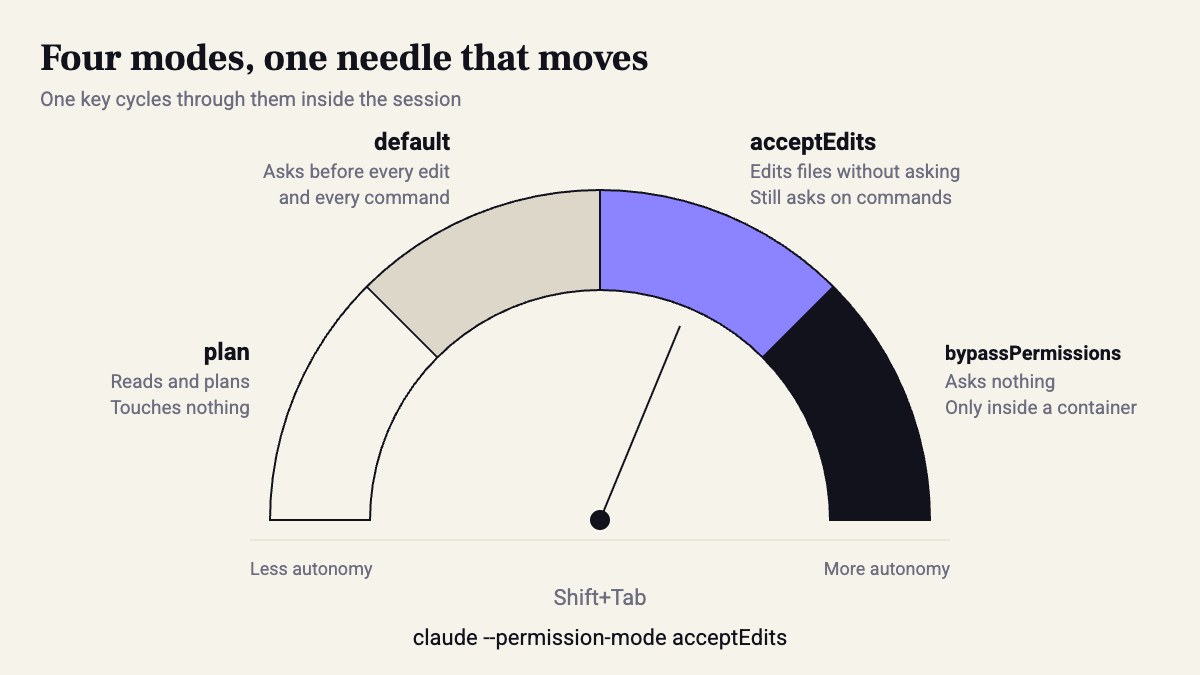
default: asks before every edit and every command.acceptEdits: edits files without asking, still asks on commands.plan: reads, plans, touches nothing.bypassPermissions: asks nothing.
Shift+Tab cycles between them. bypass only joins the cycle if you launched with --allow-dangerously-skip-permissions, and that’s on purpose. My setup: plan for a task I’m not sure about, acceptEdits once I’ve approved a plan and I’m on a clean branch, and bypass only inside a container with no credentials. The Replit agent that deleted a production DB in July 2025 is exactly the scenario that long flag is trying to prevent. To set a fixed starting mode: --permission-mode on the command line, or defaultMode in settings as in the file above.
The team also uses Cursor and Codex. CLAUDE.md, AGENTS.md or .cursorrules?
AGENTS.md is the open format, and according to its site it’s already in more than 60,000 open-source projects. Codex and Cursor read it. Claude Code looks for CLAUDE.md. .cursorrules is Cursor’s old format; today they use .cursor/rules. So write it once in AGENTS.md, and CLAUDE.md becomes an @AGENTS.md line plus whatever is Claude-specific. That way you don’t end up with three files that slowly stop agreeing with each other. What goes into the file itself we covered in part 1; this is only about where to put it.
The session is getting muddled. /compact or /clear?
/compact summarizes the conversation and keeps only the summary in context. You can steer it: /compact keep the schema decisions. /clear throws everything away and starts a new session, and since version 2.1.211 it also resets the cost counter in /usage. Rule of thumb: same task and a heavy context, /compact. New task, /clear. From the terminal: claude -c (--continue) returns to the last conversation in the directory, and claude -r (--resume) lets you pick from a list.
My take: I almost never use
/compact. The automatic summary loses exactly the detail you’ll need ten minutes later. Three lines of handoff from part 3 followed by/clearcome out cheaper and more precise.
On a subscription, /usage shows $40. Do I pay that?
No. If you’re looking for /cost from older versions, the numbers now live in the Session block of /usage, and they’re computed locally: tokens times list price. On Pro, Max or Team you pay a flat fee, and what limits you is the usage quota on that same screen, not the dollars. On the API it is your money, roughly. The estimate doesn’t know about a contract discount unless an admin set modelPricing in managed settings, and before 2.1.239 it also left out the 1.1x data-residency multiplier. The real bill is on the Usage page in the Console.
So what do you change on Monday?
"model": "sonnet"in settings.json, and Opus via/modelwhen Sonnet gets stuck.- Every subagent that scans or summarizes gets
model: haiku. - plan before a fuzzy task,
acceptEditsfor execution, bypass only in a container. - One AGENTS.md, and a CLAUDE.md that imports it.
/clearbetween tasks, not between days.- A week of
/usageat the end of every day, and in scripts--output-format jsonwithtotal_cost_usdwritten to a log. Over $30 a day on the API? First check how much of it is Opus.
And a task that repeats every day and has a clear rule doesn’t need any model. It needs a script.
Sources
How this was made: drafted by our agent from 7 sources, edited and approved by Koby Almog.